
Sand wines of the Po Delta: the vines that grow on their own roots
A tiny insect, arrived from America presumably on some steamship, starts moving in the cracks underground. It stings the roots, makes them rot, and within a few decades destroys a large part of Europe's vineyards. From the second half of the 1800s to the early 1900s, wine growing faces a very grave crisis. Huge numbers of vines die, and the remedy to save them becomes grafting European plants onto American roots, which tolerate the parasite.
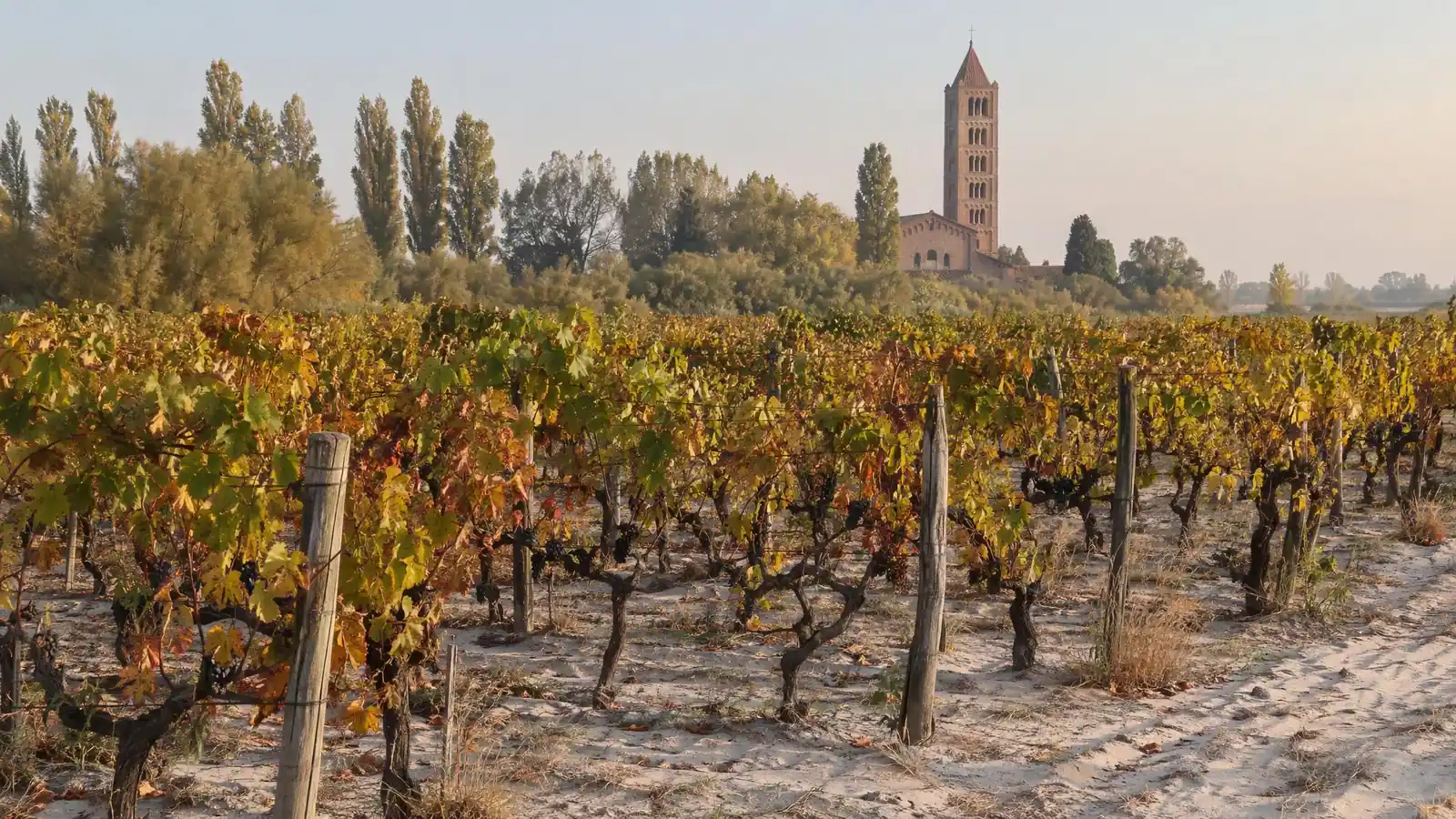
And yet, in a few places, this did not happen. If you cross the Po di Goro, along the dune ridges near the Adriatic sea, you will find rows of vines that sink their original roots straight into the ground. No grafting, no tricks. These are ungrafted vines (a piede franco), which survived phylloxera thanks to an unexpected ally: sand.
This is the story of the Vino delle Sabbie (the wine of the sands), of the Fortana, also known as Uva d'Oro, and of the monks who kept its cultivation alive in the Middle Ages. A story that helps explain why, for more than a century, the lightly sparkling red of these dunes has been brought to the table with eel, with fried fish and with the cured meats of the area.
IN THIS ARTICLE
- The scourge from America
- The miracle of sand that hinders the insect
- What piede franco is and where it survives around the world
- Where the Vino delle Sabbie comes from: a clarification
- Two thousand years of vines among the marshes
- The princess, the Uva d'Oro and the historical truth
- The Fortana: the wine that bubbles in spring
- The historic wineries of the Bosco Eliceo
- God, the eel and the wine of the wood
- Corte Madonnina: the wine we serve at Ponte Molo
- Frequently asked questions
- Taste the Vino delle Sabbie at Ponte Molo
The scourge from America
To understand why sand wines survived, you first have to look the enemy in the face. It is called phylloxera, an aphid native to North America that attacks both the leaves and the roots of the plant. While American roots tolerate the insect, European ones react to the stings by developing swellings that look like tiny birds' heads. These formations rot, destroying the root system and leading the plant to an inexorable decline.
In France, in the 1800s, three scholars identify the insect, but the infestation keeps spreading. The damage is enormous: French wine production collapses. An entire rural economy is brought to its knees and some winegrowers begin to import resistant American vines to use as rootstock.
In Italy the first anomalous declines were noticed around Lecco, but the presence of phylloxera was officially confirmed in Lombardy soon after. Despite disinfecting the rooted cuttings in hot water and the containment laws, the advance continues.
The toll is very heavy: a quarter of Italian vineyards was destroyed or seriously damaged, with the insect by then present in almost every province. The remedy that worked on a large scale was to replant with European vines grafted onto American roots. The exceptions are few, and among them are sandy soils.
The miracle of sand that hinders the insect
What makes sand so special that it protects the vine where so many nineteenth-century remedies were not enough? Studies indicate that the decisive factor is the structure of the soil, although the precise reasons are still debated. Sand hinders the path of the young larvae, and planting in these soils protects the plants from infection.
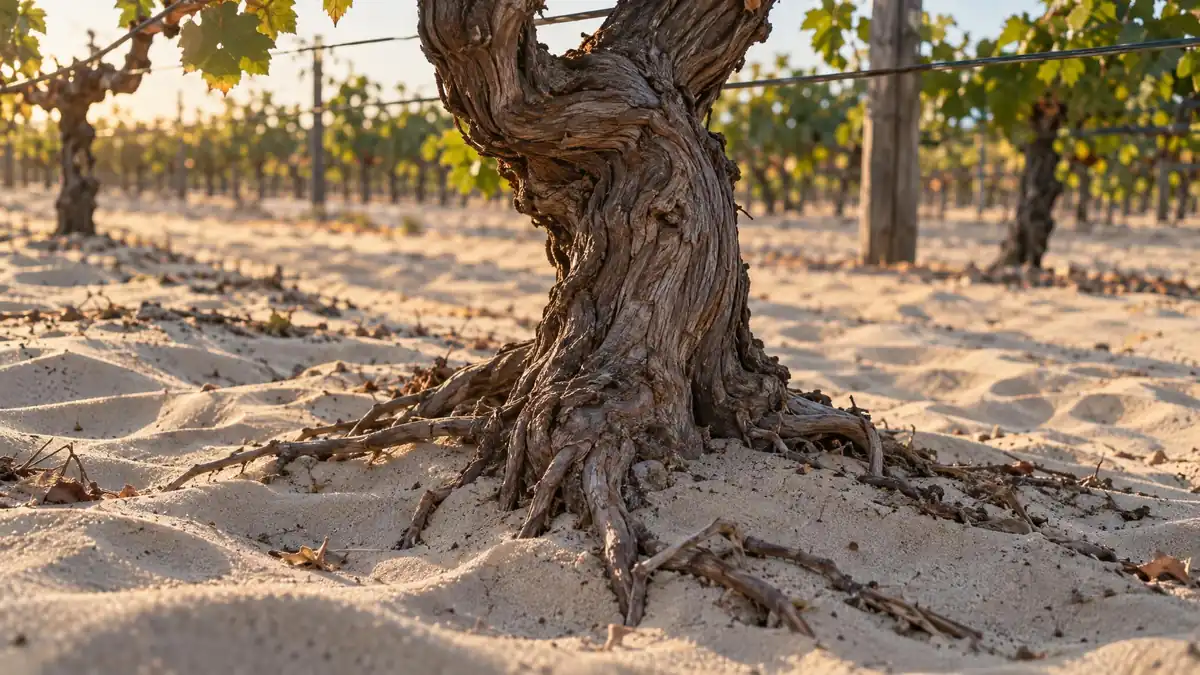
In clay soils the insect moves from one root to another using the cracks in the earth. Sand, by contrast, does not crack. The lack of a permanent structure seems to hinder the mobility of phylloxera underground, and the spaces between the grains may collapse on themselves. Below 65% sand the risk of infestation is high, above 80% it is low.
In the Bosco Eliceo, in the Ferrara part of the Delta, sand ranges from 50% in the more inland sites to over 90% close to the sea, with peaks of up to 97% on the coastal strip. Vittorio Scalambra, of Corte Madonnina, has a theory of his own: if the insect laid its eggs, they would be dragged down into the little tunnels that form in the sand.
DID YOU KNOW...
The technical rules of Sardinia require American rootstock. Planting vines on their original roots is allowed as a derogation only where it is a traditional practice and on soils that show more than 60% sand and less than 5% clay.
What piede franco is and where it survives around the world
When in the world of wine we speak of "piede franco", we mean exactly this: a vine that grows proudly on its own roots, without having been grafted onto an American base. It is the way vines were grown in Europe before phylloxera, and which today is a rarity, a fragment of agricultural history that has stayed as it was.
The Ferrara Delta is not the only one: other places in Europe have kept ungrafted vines, on sand, on volcanic soils or at high altitude. In Portugal, the vineyards of Colares sink their roots up to eight metres into dunes of pure sand. In France, a parallel with our territory is found in the Sable de Camargue, in the Rhône delta, where sand vineyards are documented as early as the fourteenth century.
In Italy, besides the Ferrara coast, piede franco survives courageously on the volcanic slopes of Etna, in the Aosta Valley, and in Sardinia, especially in the Sulcis. This is therefore not a simple local curiosity, but an agricultural heritage of inestimable value, which lets us taste wines born from vines grown as they were before phylloxera arrived.
Precisely to protect and enhance this biodiversity, a dedicated Italian committee was founded. The aim is ambitious: to collect, record and protect every grape variety or single vine on piede franco, and to work towards UNESCO recognition. A deserved recognition for those who farm the land listening to the rhythms of an ancient time.
Where the Vino delle Sabbie comes from: a clarification
If you sit down at Ponte Molo, at the entrance to Porto Tolle, and order a glass of Vino delle Sabbie, you should know that the wine comes from the other side of the Po di Goro.
Sand wine is above all a Ferrara and Ravenna production: the Bosco Eliceo DOC covers municipalities along the coastal strip from the mouth of the Po di Goro to that of the Reno. The one we pour is from Corte Madonnina, at Pomposa di Codigoro. But the Po Delta, for those who live it every day, is a single great territory of water and mist, and serving the wine of the Bosco Eliceo here means joining at the table what the maps divide.
Two thousand years of vines among the marshes
The story of the vine in these lands begins long before man learned to govern the waters with the great pumping stations. Already in ancient times there were vines in the Delta area. The geographer Strabo noted with amazement a singular phenomenon: the marshes made the vine grow quickly and with a great abundance of fruit, but the plant died out within a few years.
Through the centuries of the Middle Ages, the winemaking tradition was probably saved and handed down by the Benedictine monks of Pomposa Abbey. Around the year 1000, they are thought to be the ones to credit for preserving the vine and developing a training system in the Ferrara area.
Then come the Este. In a letter from the 1500s, a gentleman busies himself obtaining for the Duke of Este a grape called "duracha", knowing how much he wanted to have it. A few decades later we read of a grape called Muracchia that "si ama grandemente a Ferrara" (is greatly loved in Ferrara), reasonably the same one.
But it is in the 1600s that the agronomist Vincenzo Tanara gives us the most honest, peasant description of the Uva d'Oro: "Non patisce a star su le viti, ancorché piova, megliora a star molto in terra ammassata, e quando pare marcia all'hora è buona" (It does not suffer from staying on the vines even if it rains, it improves from lying a long time heaped on the ground, and when it seems rotten then it is good). A grape that stands up to rain and even improves when it seems rotten.
The princess, the Uva d'Oro and the historical truth
Around the name of the main grape of the sands, the Fortana or Uva d'Oro, revolves one of the most fascinating and persistent legends of our territory. The story goes that in the 1500s, on the occasion of her wedding, Princess Renée of France brought with her as a dowry a rooted cutting from the Côte d'Or, in Burgundy. From here the name Uva d'Oro (golden grape) would derive.
It is a romantic story, perfect for enriching the tales of Renaissance banquets, but in the documents it finds no confirmation, and the papers bring us back to a more concrete reality.
The first to suggest a French origin for the grape was Vincenzo Tanara, over a century after that wedding. In the 1800s, Count Giuseppe di Rovasenda offers a simpler explanation: it would be called Uva d'Oro for the richness of its produce.
Today genetics adds another doubt, placing the Fortana rather close to local varieties. Vittorio Scalambra, of Corte Madonnina, says he found no historical sources linking this wine to the Este. The Fortana, reading the papers, does not need a princess: it is the child of those who have farmed these sands for centuries.
The Fortana: the wine that bubbles in spring
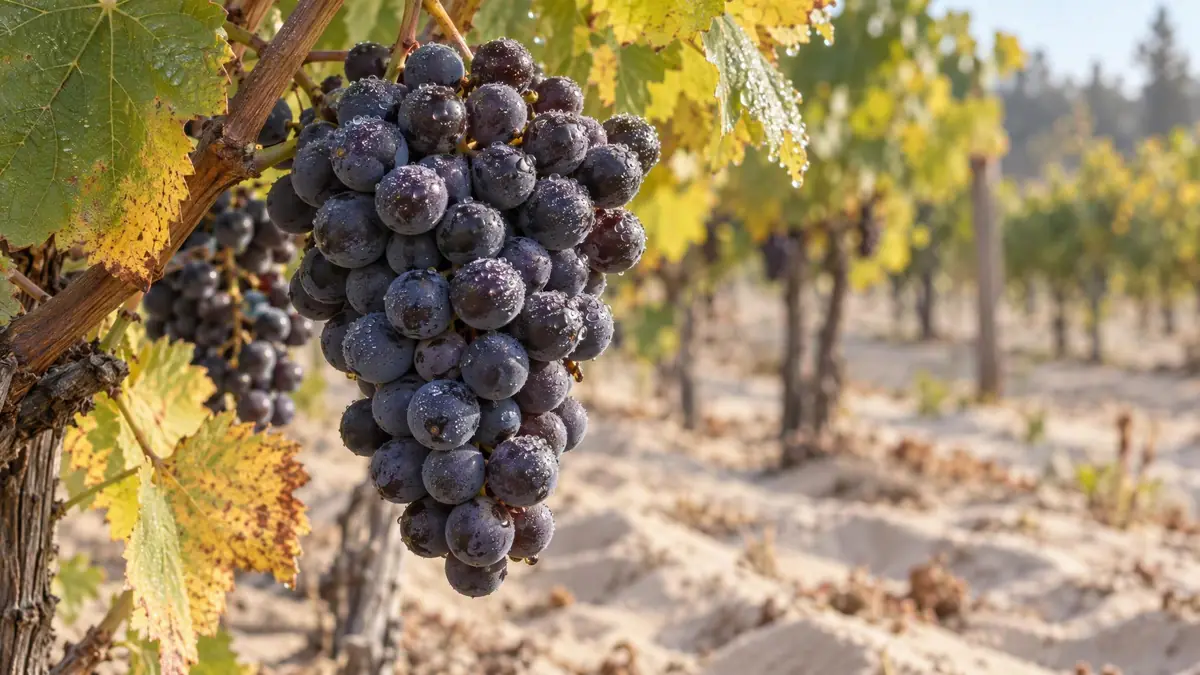
What kind of wine is this Fortana, then? The name would come from "Fruttana", or from a Fortana family, owners of vast vineyards by the sea at San Giuseppe di Comacchio. It is a ruby-red wine, moderately tannic, savoury, with a good alcohol content.
Its best-loved feature, the lively light sparkle, historically comes from a whim of the climate. The Fortana ripens late. Tradition had it that the harvest was as late as possible, towards late autumn, so fermentation often stopped because of the low winter temperatures. The wine put into bottle started fermenting again the following spring-summer, and this is how the bubbles were born. The writer Alfredo Panzini was already speaking of "bottiglie crepitanti" (crackling bottles) of Bosco wine.
Today times have changed: the Fortana, which was once picked in October, is picked in September, almost a month earlier.
Alongside the Fortana, the sands keep other gems. There is the Vodorin, a dialect name meaning "uva dorina", a grape related to the Fortana, which was once planted alongside it because it ripens earlier and makes more sugar in cold, rainy autumns. And there is the Rossiola, a pink-berried variety. Almost extinct at the end of the twentieth century, the Rossiola was saved thanks to the determination of the Scalambra family of Corte Madonnina, who preserved and replanted some surviving cuttings. From this grape comes the Ursiola, the young rosé that the producer Marino Fogli says was drunk on 11 November, St Martin's day, with eel. And of St Martin's day, a Veneto proverb says, "A San Martin tuto el most deventa vin" (On St Martin's day all the must becomes wine).
The historic wineries of the Bosco Eliceo
The protected production area takes the name of Bosco Eliceo. The origin of the name is debated: one hypothesis is that it comes from the Latin ilex, the holm oak that formed the thick woods of the area, while others linked it to ancient myths about the Sun.
In the 1930s people expected specialised vineyards to occupy thousands of hectares of sands. The peak probably came in the thirty years after the war, but subsidised grubbing-up campaigns then drastically reduced the vineyards. Today, in the whole province of Ferrara, a little over five hundred hectares remain.
Among these are historic names. There is the Mariotti winery, which looks after the Fondo Luogaccio, a historic vineyard known by the old name of Duna della Puia.
There is Ca' Nova of Marino Fogli at the Lido degli Scacchi, which still remembers his grandfather's wise advice about the vineyard: "Lasciami povera se vuoi che ti faccia ricco" (Leave me poor if you want me to make you rich). And there is the Mattarelli wine estate, with origins in the Osteria di Palìna, opened in the years just after the war. A story we feel close to: Ponte Molo too was born as a small osteria, and for Emanuele Mattarelli too "everything is born from an osteria and not from the land".
God, the eel and the wine of the wood
How do you drink a wine born on sand? The answer was given, with a lightning summary, by the writer Alfredo Panzini in 1907. Visiting Comacchio, which he described as the town where nothing but eel is eaten, he wrote this sentence: "Iddio accanto all'anguilla ha messo il vino di bosco!" (God has put the wine of the wood next to the eel!).
Panzini had understood everything. He wrote that the local people drink that wine, "forte e sapido" (strong and savoury), with their eels, "senza di che non sarebbe digeribile la grassa anguilla" (without which the fat eel would not be digestible). It is a traditional pairing, a "love match" that has lasted for more than a century: the moderate tannin and light acidity of the Fortana help balance the richness of the eel. For a similar reason, the lightly sparkling Fortana "cuts through the fat" of the salamina da sugo, a rich, structured dish from Ferrara.
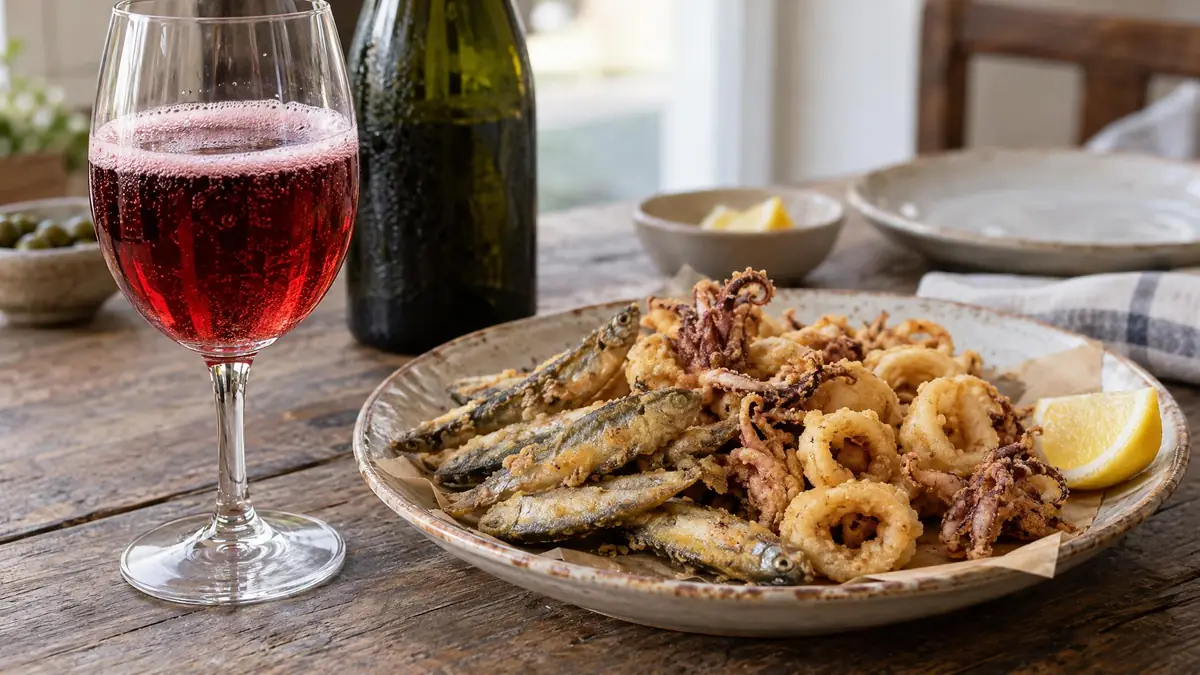
But there is another union that brings out this wine in a surprising way: fried fish. Sand wines stand up to the dishes of lagoon tradition, and according to Marino Fogli of Ca' Nova, "with sea fish no white wine can stand comparison".
A detail to enjoy it at its best: even though it is a red wine, the lightly sparkling Fortana should be served cool, at a temperature between 12 and 15 degrees. And for a toast there is a Veneto proverb: "vin vecio e dona zovene" (old wine and a young woman).
Corte Madonnina: the wine we serve at Ponte Molo
The Vino delle Sabbie we serve comes from a specific winery: Corte Madonnina. Located at Pomposa di Codigoro, a few steps from the ancient monastery, this estate in the Parco regionale del Delta del Po (the Po Delta regional park) grows ungrafted vines.
Founded in the 1960s, it is now run with passion by the children, Vittorio and Rita. Their vineyards grow on ridges of marine dunes, on soils that reach up to 95% sand. From here come the Fortana del Bosco Eliceo PDO, both still and lightly sparkling, and the Micrologus, a pure Merlot dedicated to the Benedictine monk of Pomposa considered the inventor of musical notes.
It is precisely the Vino delle Sabbie of Corte Madonnina that we have chosen to pour into the glasses on our tables at Ponte Molo.
If you come to see us on a Wednesday evening, you will find it in our Mercoledì Fritto. With Na Barca de Fritto we serve two glasses of Vino delle Sabbie. And for those who like the playful side of dinner, a glass of Vino delle Sabbie is also one of the prizes of the Timone game, the one on the QR page at the table. A simple, convivial way to taste a piece of Po Delta history.
Frequently asked questions
What are sand wines and where are they made?
Sand wines are made on the coastal strip between the mouth of the Po di Goro and that of the Reno. They grow on soils made up mainly of marine sand. The main grape varieties protected by the Bosco Eliceo DOC are the Fortana (also known as Uva d'Oro), the Merlot, the Sauvignon and the Trebbiano.
What does Bosco Eliceo mean?
Bosco Eliceo is the name of the production area and of the DOC. The origin of the name is debated: it may come from the Latin ilex (holm oak), for the oak woods that once covered the area, or be linked to ancient myths.
What kind of wine is the Fortana, is it sparkling?
The Fortana is a ruby-red wine, with a savoury taste and moderately tannic. Traditionally it is a lightly sparkling wine: in the past the late harvest meant that fermentation stopped in the winter cold, then started again spontaneously in the bottle the following spring-summer.
What is the difference between Fortana del Bosco Eliceo and Fortana del Taro?
They are two different wines in territory and in soil. The Fortana del Bosco Eliceo DOC grows on the sandy soils of the coast, partly on ungrafted vines. The Fortana del Taro IGT, on the other hand, is made in the province of Parma where the vine takes hold in clay soil.
What does piede franco mean, and what is the difference from American rootstock?
A vine on "piede franco" grows naturally on its own original roots. "American rootstock" (piede americano), on the other hand, is a rootstock: after phylloxera arrived in Europe, to save the vines people turned to grafting onto the roots of American species that tolerated the parasite. In the sands of the Bosco Eliceo there are vines that have stayed on their own roots.
What is phylloxera and when did it arrive in Italy?
Phylloxera is an insect native to North America that stings and destroys the roots of European vines. The first anomalous declines in Italy were noticed in the 1800s, and within a few decades a quarter of Italian vineyards was found to be destroyed or seriously damaged.
What do you pair a sand wine with and at what temperature do you serve it?
The historic pairing is with eel, because the tannin helps balance the richness of the fish. It is perfect also with fried fish, with cured meats and with salamina da sugo. Even though it is a red wine, it should be served cool, at a temperature between 12 and 15 degrees.
Taste the Vino delle Sabbie at Ponte Molo
After discovering the tenacious story of the vine that survived the insect, all that is left is to sit down at the table and taste the result. Since 1953, Ponte Molo has been the osteria born to welcome fishermen and farmers at the entrance to Porto Tolle, right on the road to the sea. Today we are a restaurant with a 3-star hotel, and our cooking continues to bring the true flavours of the Po Delta to the plate.
We are open every day, for lunch from 12:00 to 14:30 and for dinner from 19:00 to 22:30. Come on Wednesday evening to try Na Barca de Fritto with the two glasses of Vino delle Sabbie from Corte Madonnina, or order our Scoglio 1953 served straight in the steaming pan. And if you want to explore the area at your ease, our rooms upstairs are waiting for you with buffet breakfast included, with local products and cakes made by us: the starting point for discovering the embankments and the Delta from first thing in the morning.
We are at Via Borgo Molo 5. Free parking is waiting for you, and the warmth of a home that recognises you.
Sources and further reading
Scheda Vodorin ex Fortana CAB1 (RER V197), Emilia-Romagna Region
Prescrizioni tecniche per impianti viticoli (deroga franco di piede), Sardinia Region
Regio Decreto 13 maggio 1883 n. 1344, testo unico sulla fillossera, Normattiva, Presidency of the Council of Ministers
Cahier des charges IGP Sable de Camargue, INAO (Institut national de l'origine et de la qualité)
Soil and Climate GIS Data-Derived Risk Mapping for Grape Phylloxera in Washington State, Frontiers in Plant Science (PMC), Washington State University
Come la fillossera ha cambiato il vino, Il Post
Viti a piede franco, una rete per il riconoscimento Unesco, ANSA
La viticoltura ferrarese (tesi di laurea), University of Bologna (AMS Laurea)
Bosco Eliceo (vino), Italian Wikipedia
La lanterna di Diogene, XVI. A Comacchio, Wikisource (text by Alfredo Panzini, 1907)
Caldo e vendemmia anticipata: «La faremo a Ferragosto», Il Resto del Carlino
Vini del Bosco Eliceo: storia e produttori, Gazzetta del Gusto
I Vini delle Sabbie di Corte Madonnina, WineMag.it
Luca e la Fortana del Taro, le bollicine segrete di Busseto, Touring Club Italiano
Continue exploring the Delta
The Po Delta bisato: nature's most mysterious journey
6,000 km to the Sargasso Sea without ever eating: the story of the world's most mysterious fish.
Read more
The Cozza di Scardovari PDO mussel: the black gold of the Po Delta
The only Italian mussel with a protected designation of origin, born where the Po meets the Adriatic.
Read more
Pink flamingos in the Po Delta
Complete guide to admiring these magnificent birds in their natural habitat.
Read moreShare this story
If this article made you curious, share it with anyone who loves wine and the Po Delta.